
Skip to content
Australia AUD
KitchenAid

KitchenAid

The icon, since 1919.

OriginUnited States
Est.1919
WarrantyUp to 5 Year Warranty
Known forThe Artisan tilt-head stand mixer, planetary mixing action, the multipurpose attachment hub, and an ever-changing palette of signature colours.
Original planetary action — 59 touchpoints around the bowlDie-cast metal body built to last decadesOne attachment hub, a whole kitchen of toolsBackward-compatible attachments going back generationsColour-led design, refreshed every year

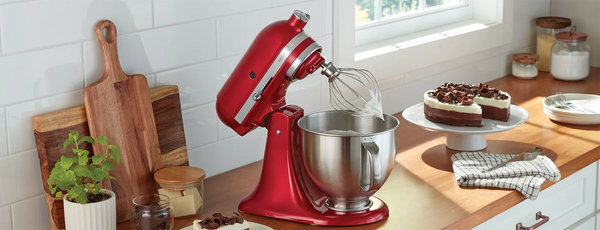
KitchenAid makes the stand mixer the rest of the world measures itself against. Born in 1919 from a heavy commercial mixer reimagined for the home, its tilt-head silhouette has barely changed in design since the 1930s — so enduring it now sits in the Museum of Modern Art's collection as an icon of American design. Behind the looks is genuine engineering: original planetary mixing action that drives the beater to 59 touchpoints around the bowl, a die-cast metal body built to outlast decades of use, and a multipurpose attachment hub that turns one machine into a pasta maker, grinder, spiraliser and more. Add a wardrobe of colours released fresh each year, and you have a benchmark that's as much a part of the kitchen as it is an appliance for it.

  • Sort by

23% Off
KitchenAid
KitchenAid Y Peeler 17.5cm (Empire Red)
$12.95$16.95
23% Off
KitchenAid
KitchenAid Ladle (Empire Red)
$12.95$16.95
23% Off
23% Off
23% Off
25% Off
25% Off
KitchenAid
KitchenAid Cotton Apron (Charcoal Grey)
$44.95$59.95
21% Off
25% Off
KitchenAid
KitchenAid Salt & Pepper Grinder Set
$59.95$79.95
EU's Take

Why We Stock KitchenAid

We've been a KitchenAid specialist since 2010 — fifteen years of selling, demonstrating and standing behind these machines. It stays on our shelves for one simple reason: it's the benchmark the whole category is measured against. The engineering earns that reputation — the original planetary action mixes more thoroughly than a cheaper machine, the die-cast body shrugs off heavy dough that sends lighter mixers walking across the bench, and a well-kept one lasts long enough to be handed down. It's the clearest case of "buy well, buy once" we can put in front of you. If you want the icon, we carry it in the colours worth having — and we'll always give you the honest version of whether it's the right call for how you actually cook.

A Century on the Bench

The KitchenAid story begins in 1908, when a Hobart engineer watched a baker labour over dough by hand and set out to build a better, mechanical way to do it. The industrial mixers that followed proved themselves the hard way — by 1917 they were standard equipment on all US Navy ships, which prompted Hobart to develop the first home model. In 1919 it launched the Model H-5, the first household stand mixer to carry the KitchenAid name — supposedly christened when a tester declared it "the best kitchen aid I've ever had."

The silhouette that made it famous arrived in the 1930s with the Model K, designed by Egmont Arens, and the mixers have changed little in design since — attachments from the Model K onward still fit modern machines. In 1997 that enduring shape was named an icon of American design by the San Francisco Museum of Modern Art. More than a century on, the heart of it is unchanged: the original planetary action, where the beater turns one way while the shaft spirals the other to reach 59 touchpoints around the bowl — proof that a tool used every day can be built well enough to last generations.

Frequently Asked Questions

Will older attachments and bowls fit a new KitchenAid mixer?

Yes — and this is one of the brand's genuine strengths. KitchenAid has kept the same multipurpose attachment hub for generations, so attachments going back decades still fit current tilt-head and bowl-lift mixers. Bowls are the exception to watch: they're sized to the model, so a 4.7L tilt-head bowl won't fit a 6.6L bowl-lift, and tilt-head and bowl-lift bowls aren't interchangeable. If you're buying a replacement or extra bowl, match it to your exact model, not just the brand.

Tilt-head or bowl-lift — which should I actually buy?

For most homes, a tilt-head (like the KSM195 or KSM45). The head tilts back for easy bowl access, it's more compact, and 4.3–4.7L handles everyday baking comfortably. Go bowl-lift (the KSM70) only if you regularly bake in large batches or work heavy bread doughs — it has more capacity and grunt, but it's bigger, heavier, and needs more bench and overhead clearance. If you're unsure, the tilt-head is the right call nine times out of ten.

How much will it dough can it actually handle? Will it "walk" across the bench?

A genuine KitchenAid won't wander like a cheap mixer because of its die-cast metal body and weight — that heft is the point. A 4.7L tilt-head handles up to around 9 dozen cookies or roughly 1kg of bread dough per batch; the 6.6L bowl-lift does noticeably more. For very heavy or frequent bread work, size up to the bowl-lift rather than pushing a tilt-head to its limit every time.

What's the difference between all the colours — do any cost more?

Mechanically they're identical; the colour is purely finish. That said, KitchenAid runs special finishes — the annual Colour of the Year and the Design Series (like Evergreen, with its walnut bowl and brass hub) — which carry premium materials and a higher price, and are often limited. Standard colours are all one price. So pick on looks for the standard range, and only pay more if you specifically want a Design Series or limited finish.

Can I make pasta, mince meat or churn ice cream with it?

Yes — that's the attachment ecosystem, and it's most of what makes the mixer worth it long-term. The hub powers a pasta roller and cutter, a food grinder for mince, a spiraliser, an ice cream bowl and more (each sold separately). One motor, a whole bench of tools. Worth knowing before you buy: budgeting for an attachment or two down the track is how most people get the real value out of the machine.

Are KitchenAid mixers dishwasher safe, and how do I look after one?

The stainless steel bowls and most coated accessories are dishwasher safe. The mixer base never goes in water or the dishwasher — just wipe it down. The coated (enamel) beaters last longest with a gentle wash. Looked after, these genuinely run for decades, which is the whole case for buying one — check your model's use-and-care guide for the specifics.

If something goes wrong, can it be repaired — or is it landfill?

This is part of what sets KitchenAid apart — these aren't throwaway appliances. They're built to be repaired and kept, not replaced, which is how a well-cared-for machine lasts decades and gets passed down. Worn or faulty parts can be serviced rather than binned. We work with an authorised service network able to assess and repair them, including warranty work. If you have an issue with your machine, contact us and we can point you in the right direction.

Does KitchenAid make more than mixers and appliances?

Far more. The same name sits across a deep range of everyday kitchen tools and gadgets — prep, baking, utensils, storage and cleaning — carrying the brand's design and durability into the things you reach for daily, at prices that are easy to own or gift. It's a big collection, and most of it lives right here.

Drawer Title
Similar Products