Skip to content
Australia AUD
acaia

acaia

Our weigh to brew.

OriginUnited States
Est.2014
Known forThe Pearl — the scale that made real-time weight, time and flow-rate measurement the specialty-coffee standard.
Real-time flow-rate tracking, not just weightLab-balance precision, hand-builtThe competition and pro-bar benchmark

acaia makes precision brewing scales for people who treat coffee as a measurable craft. Its scales don't just weigh — they track weight, time and flow rate in real time, connecting to an app that graphs your pour as you make it. The range spans the pour-over-focused Pearl, the espresso-bench Lunar, the display-free Umbra, plus the Orbit grinder and Orion dosing system. Lab-grade accuracy in minimal, hand-built aluminium hardware.

Filter
  • Sort by

New
acaia
Acaia Pearl USB Port
$27.95
New
acaia
Acaia Tea Scoops
$87.95
New
acaia
Acaia Pearl Carry Case
$129.00
New
acaia
Acaia Titan Brew Stand
$389.00
EU's Take

The variable you didn't know you were missing

Most people dialling in their coffee obsess over grind and dose and never think about pour rate — and it's often the thing holding them back. That's what an acaia does that a $30 kitchen scale can't: it shows you flow in real time, so you can actually see and fix what your hands are doing. Is it a lot for a scale? Yes. But if you've already spent on a good grinder and beans and you're still getting inconsistent cups, this is usually the missing piece. Start with the Pearl for filter, or the Lunar if espresso's your thing. It's a precision instrument, and it's priced like one — but it earns it.

Coffee, weighed like a lab

acaia came from an unusual pairing of skills. Its founders had spent years building laboratory precision balances — the exacting instruments used to weigh in fractions of a gram — and designing consumer products. Somewhere in that overlap they noticed specialty coffee had a gap: baristas obsessed over precision, but the scales they used were crude compared to what a lab took for granted, and none of them were built to be beautiful.

So they built the scale they wished existed. The Pearl was developed in 2013, funded on Kickstarter, and launched at the 2014 SCAA Expo, where it won Best New Product. What set it apart wasn't just accuracy — it was the idea that a scale could track time and flow rate alongside weight, and connect to software that let you see and repeat a brew. That thinking turned a humble scale into a genuine brewing instrument, and it spread from origin sourcing trips to World Brewers Cup stages to home kitchens. acaia has since grown into grinders and dosing systems, but the founding idea holds: bring laboratory precision to coffee, and make it something you actually want on your bench.

Frequently Asked Questions

Pearl or Lunar — which one should I get?

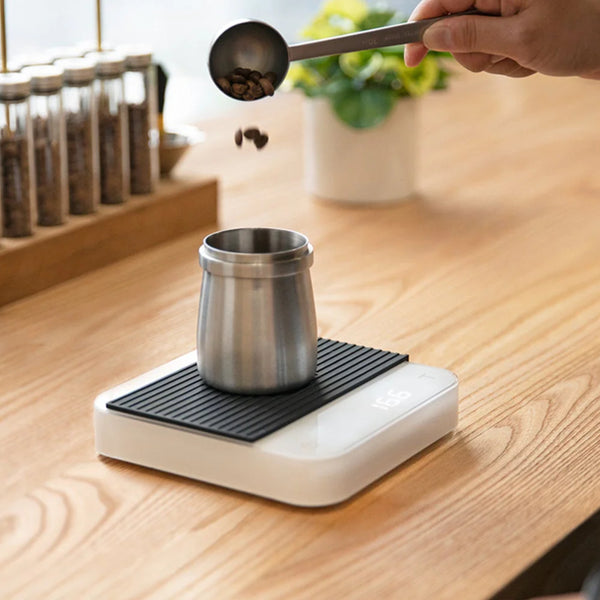
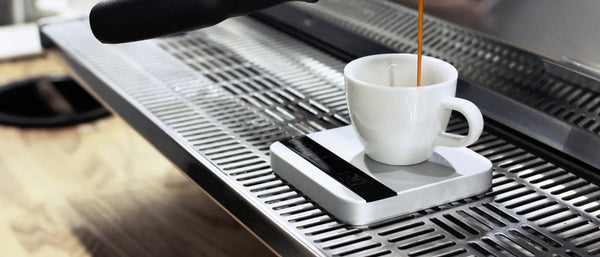
It comes down to how you brew. The Pearl has a larger platform built for pour-over, French press and larger carafes — it's the all-rounder and the one to get for filter coffee. The Lunar is smaller and purpose-built for espresso: it's slim enough to fit under most machine group heads on the drip tray, and it's more water-resistant and rugged for the espresso bench. Rule of thumb: filter and manual brewing → Pearl; espresso on the machine → Lunar. Both weigh, time and read flow rate; the difference is size and durability, not accuracy.

What does a coffee scale do that my kitchen scale can't?

Three things. It reads to 0.1g with a roughly 20-millisecond response, so it keeps up with a live pour instead of lagging behind it. It has a built-in timer that runs alongside the weight, so you track dose, yield and time together. And it shows flow rate in real time — how fast you're pouring — which is the variable most brewers never see and the one that quietly wrecks consistency. A kitchen scale gives you a number a second too late; an acaia gives you the full picture as it happens.

Do I need the app, or does the scale work on its own?

The scale is fully standalone — weigh, time, tare and read flow rate without ever opening the app. The app adds recipe graphing, saving and brew guides for people who want to dial in and repeat a specific pour, and acaia pushes firmware updates that improve the scale over time. Plenty of owners never use the app and love the scale regardless. So buy it for the hardware; treat the app as a bonus, not a requirement.

Is it water-resistant? Can I leave it on the espresso drip tray?

The Lunar is designed exactly for that — anodised aluminium with water-resistant-coated electronics, built to shrug off splashes, steam and the odd knock on a working bench. The Pearl is water-resistant enough for careful home use but isn't built to live in an espresso machine's splash zone long-term. Neither is fully waterproof — don't submerge them — but for espresso duty on the tray, the Lunar is the one made for the job.

How's the battery — do I need to keep buying cells?

No disposable batteries. Both scales run on a built-in rechargeable battery you top up over USB, giving roughly 30–40 hours of use per charge. Owners report the battery still holding up years down the track. It's one less consumable to think about, and a big part of why these last.

Drawer Title
Similar Products